

Table of Contents
White Eyeliner:
White eyeliner is not just a bold aesthetic choice. It is a calculated highlighting tool that restyles how light interacts with the eye area, allowing you to control brightness, contrast, and perceived eye size with precision.
Most people try white eyeliner once, find it looks stark or theatrical, and assume it belongs only in journalistic makeup. That reply usually comes from using it like a black liner. The direct answer: white eyeliner works when it is treated as a placement-based highlighting tool, not a framing tool. When applied with restraint and the right texture, it can make eyes look clearer, more awake, and Who This Guide Is For
This is for:
- Beginners who want to understand why and where to apply white liner.
- Makeup users who feel black liner looks heavy but still want eye definition.
- Artists looking to control brightness without shimmer.
This is not for:
- Those seeking dramatic, full graphic liner techniques (this focuses on wearable structure first).
- Anyone expecting a one-product shortcut—this is about method, not gimmicks.
Why White Eyeliner Works:
In graphic design, lighter colors fee and shadier colors withdraw. White eyeliner reflects ambient light, which:
- Expands perceived eye space.
- Reduces shadow density around the lash line.
- Mimics the natural brightness of the sclera (the white of the eye).
- Signals alertness to the viewer’s brain.
This same principle is used in portrait lighting and dermatological cosmetic guidance discussed by organizations like the American Academy of Dermatology—brightness and contrast influence how “rested” skin and eyes appear.
Think of white liner less like drawing a line and more like placing a light source.
White vs. Nude vs. Black Eyeliner — Functional Differences
| Feature | White Eyeliner | Nude Eyeliner | Black Eyeliner |
| Primary Role | Brightening | Soft correction | Framing |
| Visual Effect | Expands space | Blends seamlessly | Adds depth |
| Best For | Tired eyes, minimal looks | Natural makeup | Dramatic definition |
| Risk | Can look stark | Can disappear | Can feel heavy |
Decision Rule:
If you want people to notice your eyes look awake, choose white.
If you want them to notice liner, choose black.
Where to Apply White Eyeliner
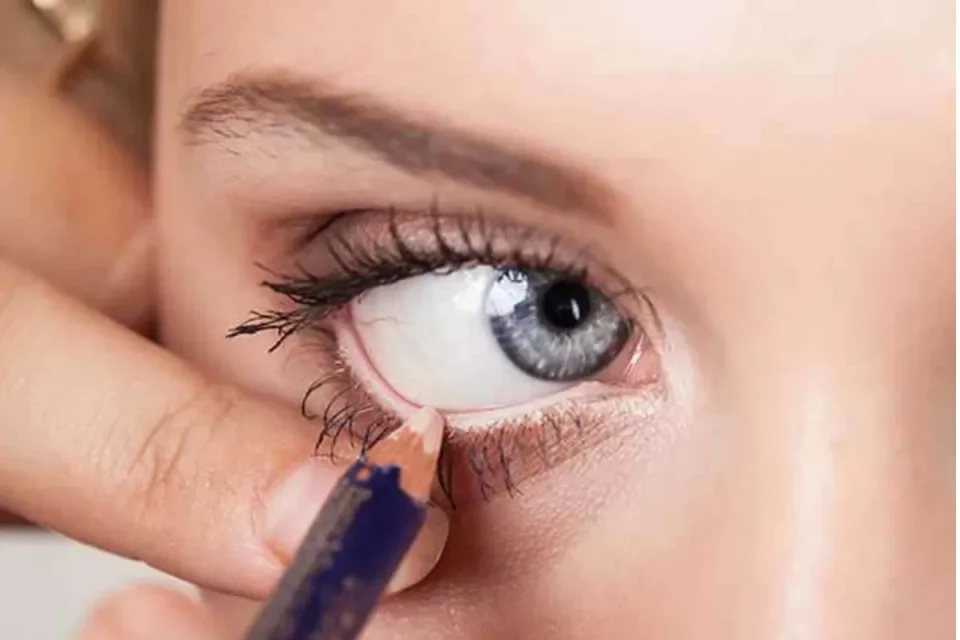
- Waterline: Instant Eye-Opening
Applying white to the lower waterline visually lowers the eye boundary.
Result: Eyes appear larger without adding makeup weight.
Common mistake: Extending beyond the iris → looks artificial.
Fix: Keep application centered.
- Inner Corner: Controlled Brightness
A small touch acts like a reflector panel in photography.
Use this when:
- You skipped under-eye concealer.
- You want a clean, modern finish.
Research in perception science often referenced by institutions like Harvard Medical School shows that brightness near the medial eye area strongly affects perceived fatigue levels.
- Upper Micro-Line: Invisible Lift
Instead of drawing a wing, press white liner between lashes.
Effect: Subtle separation without visible liner.
This is ideal for:
- Hooded eyes.
- Mature skin where dark liner can collapse space.
Choosing the Right Formula
| Formula | Finish | Use Case | Watch Out For |
| Cream Pencil | Skin-like | Daily wear | Needs sharpening |
| Gel | Controlled brightness | Long days | Can build too opaque |
| Liquid | High contrast | Graphic looks | Least forgiving |
Rule: The stronger the pigment, the less minimal the rest of your makeup must be.
Dermatology focused institutes such as Dressing Hospital often highlight choosing designs suited to sensitive eye areas—creamy textures are typically more relaxed for frequent use.
Adapting White Eyeliner to Different Skin Tones
White does not act the same on every single complexion.
| Skin Depth | Adjustment Needed | Why |
| Fair | Use sparingly | Prevent chalkiness |
| Medium | Blend edges | Maintain harmony |
| Deep | Sheer application or layer over taupe | Avoid stark contrast |
Key Insight: Diffusion matters more than shade matching.
Common Mistakes
| Mistake | Why It Happens | Correction |
| Drawing thick lines | Using black-liner habits | Apply in micro strokes |
| Using flat matte | Emphasizes texture | Choose satin finish |
| Skipping mascara | Removes anchor | Always balance with lashes |
| Applying everywhere | Too much reflectivity | Limit to one zone |
Fix Framework:
Place → Diffuse → Anchor → Stop.
Most people fail at the last step.
Making White Eyeliner Work for Daytime
To keep it wearable:
- Pair with neutral shadows (not shimmer).
- Use skin-focused base makeup.
- Add mascara to restore contrast.
- Avoid pairing with heavy contour—it fights the brightness effect.
Real-World Scenario:
If you normally wear concealer + black liner for meetings, swap to:
- Light concealer
- White waterline
- Mascara
You’ll get alertness without visible makeup weight.
When to Use It for High-Impact Looks
White eyeliner scales beautifully into bolder aesthetics when intentionally amplified:
- Graphic shapes for editorial styling.
- Contrast liner for photography (flash flattens depth).
- Minimalist runway-inspired makeup.
In these cases, opacity is desirable—but structure must stay clean.
Quick Application Framework
- Sharpen or control the tip—precision is everything.
- Choose one placement zone, not multiple.
- Apply in short presses, not strokes.
- Blend edges slightly using a small brush or fingertip.
- Finish with mascara to rebalance contrast.
This takes under 60 seconds once practiced.
Practical Comparison: Subtle vs. Statement Use
| Approach | Placement | Product Type | Result |
| Everyday Brightening | Waterline | Cream pencil | Awake, natural |
| Soft Definition | Lash base | Gel | Modern clarity |
| Editorial Contrast | Graphic lid | Liquid | Bold, stylized |
Limitations and Trade-Offs
White eyeliner is not universally flattering in every situation.
- Can emphasize texture if applied too thickly.
- Requires balance—works best with restrained surrounding makeup.
- Not ideal for very watery eyes unless using long-wear formulas.
It’s a precision tool, not a shortcut product.
Conclusion
White eyeliner is often misheard because it’s used like a traditional liner rather than as a light placement system. When applied strategically, it becomes one of the most efficient ways to make eyes look brighter, clearer, and more planned without adding visual weight. The difference between “chalky” and “refined” is not the product—it’s the restraint, placement, and texture choice behind it.
FAQ’s
- Does white eyeliner make eyes look bigger?
Yes—but only when applied to areas that expand perceived light, like the waterline or inner corner. Thick lines cancel the effect. - Is white eyeliner better than nude eyeliner?
White creates visible brightness; nude creates subtle correction. Choose based on how noticeable you want the effect. - Can mature skin wear white eyeliner?
Absolutely. In fact, it often works better than black because it doesn’t create harsh contrast. Use creamy, blendable formulas. - Why does my white eyeliner look harsh?
Usually because it’s too opaque or applied too widely. Reduce coverage and diffuse edges. - Should I pair it with eyeshadow?
Yes—soft neutral shadows help integrate the brightness so it looks intentional, not floating. - Is white eyeliner only for trends?
No. It’s widely used in professional makeup to control brightness and perception, even in very natural looks.