

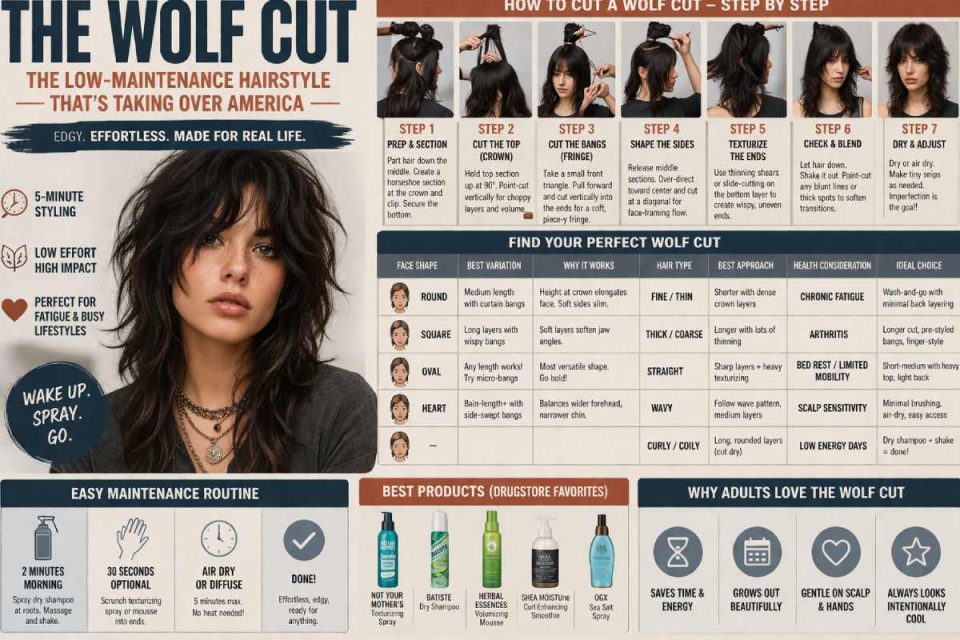
In the last two years, few hairstyles have taken the United States by storm quite like the wolf cut. From TikTok tutorials with millions of views to salon requests in every major city—New York, Los Angeles, Chicago, and beyond—this choppy, layered look has become a cultural phenomenon. But beyond its edgy, effortless aesthetic, the wolf cut offers something far more valuable for many adults: a way to look stylish with minimal daily effort.
For Americans juggling demanding jobs, family responsibilities, and the physical toll of chronic fatigue, long commutes, or health challenges, spending 30 to 45 minutes on hair styling each morning is simply not sustainable. The wolf cut was born from this exact need. It combines the volume of a 1970s shag with the attitude of a mullet, but its true genius lies in its low-maintenance nature. It is designed to look intentionally messy, lived-in, and textured—meaning you can wake up, spray a little dry shampoo, shake your hair out, and walk out the door looking like you just stepped out of a fashion editorial.
This article is your complete guide to the wolf cut in the United States. We will explain exactly what a wolf cut is, provide a detailed step-by-step table for cutting it (at home or for your stylist), and offer a comprehensive guide table covering face shapes, hair types, and health considerations. We will also explore why this hairstyle is particularly beneficial for adults dealing with fatigue, arthritis, or limited mobility, and where to find the best wolf cut inspiration and resources across the US.
Table of Contents
What Exactly Is a Wolf Cut?
The wolf cut is a hybrid hairstyle that merges two iconic looks: the shag haircut (popularized in the 1970s) and the mullet (a rebellious 1980s staple). The result is a cut characterized by:
- High volume at the crown – short, choppy layers that lift the hair up and away from the scalp.
- Tapered sides – softer than a classic mullet, with blended layers that frame the face.
- Longer, wispy back – not as extreme as a traditional mullet, but enough to create contrast and movement.
- Statement bangs – usually curtain bangs or a choppy fringe that blends into the side layers.
The name “wolf cut” comes from the way the layers mimic the natural, wild texture of a wolf’s mane. It is intentionally imperfect, slightly rebellious, and highly customizable.
Unlike the sharp, geometric cuts of the past, the wolf cut relies on point-cutting and slide-cutting techniques to remove weight and create soft, feathered ends. This makes it flattering for virtually all hair types: straight, wavy, curly, thick, or fine. In the United States, the wolf cut gained massive traction on TikTok in 2021 and has since become a permanent request in salons from coast to coast.
Why the Wolf Cut Is Perfect for Adults with Fatigue or Health Concerns
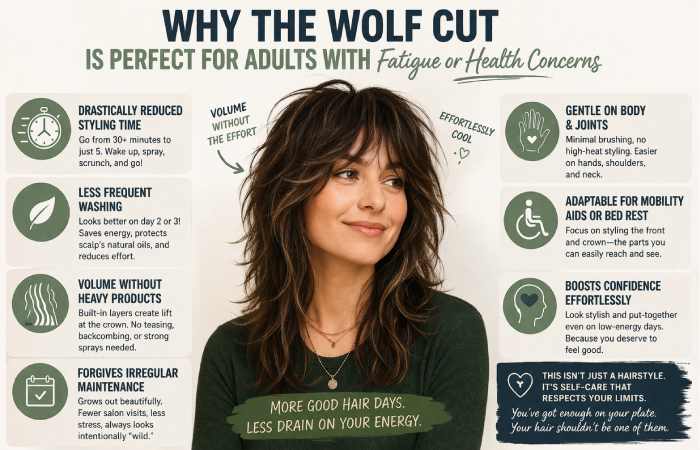
Before we dive into cutting and styling, it’s important to understand why this trend resonates so strongly with adults who experience fatigue, low energy, or physical limitations.
1. Drastically Reduced Styling Time
Traditional long hair or precision bobs require blow-drying, flat ironing, or curling to look “done.” A wolf cut, by contrast, is designed to look effortlessly messy. Most wearers can simply:
- Apply a texturizing spray or mousse to damp hair.
- Scrunch or shake with fingers.
- Air dry or use a diffuser for 5–10 minutes.
For someone with chronic fatigue, arthritis in the hands, or shoulder pain, cutting styling time from 30 minutes to 5 minutes is life-changing.
2. Less Frequent Washing
The choppy, textured layers of a wolf cut actually look better on second- or third-day hair. Dry shampoo can be worked into the roots and layers without looking greasy. Washing hair less often:
- Preserves natural scalp oils.
- Reduces physical effort (bending, scrubbing, rinsing).
- Lowers hot water and blow-dryer usage, which is gentler on hair health.
3. Volume Without Heavy Products
Fine or flat hair often requires teasing, backcombing, or strong-hold sprays to achieve volume. These actions take time and manual dexterity. The wolf cut builds volume directly into the haircut through its short, stacked crown layers. Even on a low-energy day, the hair will naturally lift at the roots.
4. Forgives Irregular Maintenance
Life with health challenges means salon visits may be postponed. The wolf cut is exceptionally forgiving as it grows out. Because the style is meant to be shaggy and uneven, a few extra weeks of growth simply enhance the “wild” look. This reduces the stress of keeping a strict 6-week trim schedule.
5. Adaptable for Mobility Aids or Bed Rest
If you use a wheelchair, walker, or spend significant time in bed, reaching the back of your head for styling can be difficult. The wolf cut’s emphasis on top and side layers means you can focus styling on the front and crown—the parts you can easily see and reach—while the back remains intentionally textured and low-fuss.
How To Cut a Wolf Cut
This table provides a professional, stylist-approved method for cutting a wolf cut. Warning: Cutting hair at home carries risks. For very curly, coily, or fine hair, consult a professional. Use sharp hair shears only.
| Step | Action | Key Tip & Technique |
| Step 1 | Prep & Section | Start with clean, damp hair. Part down the middle. Create a “horseshoe” section at the crown and clip away the top third. Secure the bottom two-thirds with clips. |
| Step 2 | Cut the Top (Crown) | Take the top section, hold it straight up at a 90‑degree angle. Use point-cutting (cutting vertically into the ends) to create choppy, uneven layers. This builds the signature wolf volume. |
| Step 3 | Cut the Bangs (Fringe) | Take a small front triangle section (about 1–2 inches wide). Pull it forward and cut vertically into the ends. Avoid a blunt, straight line. The goal is a soft, feathered, piece-y fringe. |
| Step 4 | Shape the Sides | Release the middle sections. Over-direct them toward the center of your head. Cut at a diagonal to create a soft, face-framing flow. This prevents the harsh “shelf” look of a bad mullet. |
| Step 5 | Texturize the Ends | Use thinning shears or slide-cutting (closing shears halfway and gliding down the hair shaft) on the bottom layer. Remove weight to create wispy, uneven ends that move naturally. |
| Step 6 | Check Symmetry & Blend | Let all hair down. Shake it out. Look for any blunt lines or thick spots. Use point-cutting to soften any harsh transitions between layers. |
| Step 7 | Dry Style & Final Adjust | Blow-dry or air-dry. Once dry, the true shape will reveal itself. Make tiny snips into any bulky areas. Remember: imperfection is the goal. |
Complete Guide to Wolf Cuts – Suitability & Customization
This table helps you decide which variation of the wolf cut works best for your unique features, hair type, and lifestyle needs.
| Feature / Concern | Best Wolf Cut Variation | Why It Works (Health & Aesthetics) |
| Face Shape – Round | Medium length with curtain bangs or side-swept fringe. Keep crown volume high. | Height at the crown elongates the face. Soft side layers draw the eye vertically, slimming the profile. Avoid blunt, heavy bangs. |
| Face Shape – Square | Long, soft wolf cut with wispy, airy bangs and rounded layers around the jaw. | Soft, textured layers neutralize sharp jaw angles, creating a more oval, balanced appearance. |
| Face Shape – Oval | Any length works. Experiment with micro-bangs or extremely choppy crown layers. | The most versatile shape allows full expression without structural limitations. |
| Face Shape – Heart | Chin-length or longer with side-swept bangs and extra volume at the crown. | Balances a wider forehead and a narrower chin. Volume on top draws attention upward, softening the heart shape. |
| Hair Type – Fine / Thin | Shorter wolf cut with heavy, dense layers at the crown. Avoid over-texturizing. | Choppy layers create the illusion of thickness and density by allowing strands to move independently and reflect light. Use volumizing mousse. |
| Hair Type – Thick / Coarse | Longer wolf cut with extensive thinning in the mid-lengths and ends. | Reduces weight, prevents the dreaded “triangle” shape, and enhances movement. Thick hair becomes much easier to manage and air-dry. |
| Hair Type – Straight | Sharp, defined layers with heavy texturizing on the ends. | Straight hair can look flat; the wolf cut adds obvious, graphic texture and movement. Use sea salt spray for separation. |
| Hair Type – Wavy | Medium layers that follow the natural wave pattern. Avoid cutting against the curl. | Waves naturally enhance the “wild” aesthetic. The cut allows waves to clump and form without frizz. Diffuse for 5 minutes. |
| Hair Type – Curly / Coily | Long, rounded layers cut when dry (to see true spring factor). Keep length. | Prevents “poofing” and triangular shapes. Curls retain their bounce and definition. Use curl cream to weigh down nothing. |
| Health – Chronic Fatigue | Wash-and-go wolf cut with minimal layering in the back. | Reduces styling time to under 5 minutes. Air-dry only. The messy look is intentional, so no perfectionism required. |
| Health – Arthritis / Hand Pain | Longer wolf cut with pre-styled bangs (no daily trimming). | Less need for blow-dryers, round brushes, or complex updos. Finger styling only. A wide-tooth comb is sufficient. |
| Health – Bed Rest / Limited Mobility | Short to medium wolf cut with heavy top layers and very light back. | Can style only the front sections while lying down. Back remains hidden and textured. Dry shampoo becomes your best friend. |
How to Maintain Your Wolf Cut
Maintaining a wolf cut is refreshingly simple compared to other trendy hairstyles. However, a little routine ensures the shape stays flattering, and the effort remains low.
- Schedule Trims Every 8–12 Weeks
Unlike a blunt bob (which requires 4–6 week trims), the wolf cut can go 8–12 weeks between salon visits. When you do go, ask your stylist for “dusting the ends and reshaping the crown layers.” Avoid heavy re-texturizing each time, as over-thinning can ruin the volume.
- Use the Right Products (US Drugstore Favorites)
You don’t need expensive salon lines. These affordable, widely available products work perfectly:
| Product Type | Recommended (Available at Target/Walgreens/Ulta) | Purpose |
| Texturizing Spray | Not Your Mother’s Beach Babe Texturizing Spray | Adds grit and separation to choppy layers |
| Dry Shampoo | Batiste Dry Shampoo (original or volumizing) | Refreshes roots, adds lift, reduces washing frequency |
| Light Mousse | Herbal Essences Body Envy Volumizing Mousse | Boosts crown volume on fine hair |
| Curl Cream (for curly hair) | SheaMoisture Coconut & Hibiscus Curl-Enhancing Smoothie | Defines curls without weighing down layers |
| Sea Salt Spray | OGX Moroccan Sea Salt Spray | Enhances the “messy, lived-in” texture |
- Styling Routine for Low-Energy Days
- Morning (2 minutes): Shake hair upside down. Spray dry shampoo at the roots. Massage with fingertips. Flip back.
- Optional (30 seconds): Rub a pea-sized amount of texturizing putty between palms and scrunch the ends.
- Done. No brushes, no heat, no tears.
- Protecting Hair While Sleeping
To preserve the shape and reduce tangles (which can be painful for those with scalp sensitivity), sleep on a satin or silk pillowcase. These reduce friction and keep the choppy layers from flattening. You can also loosely pile hair on top of your head in a “pineapple” (using a scrunchie) – this actually enhances the crown volume by morning.
Where to Get a Wolf Cut in the United States
While many people successfully cut their own wolf cut at home (thanks to TikTok tutorials), a professional stylist will always achieve a more balanced, long-lasting result. Here are the best ways to find a wolf cut specialist:
National Salon Chains That Understand the Trend
- Supercuts – Many locations now offer “wolf cut” as a menu option. Call ahead to confirm the stylist has watched the training videos.
- Great Clips – Less reliable, but some stylists are trend-savvy. Bring clear photos.
- Ulta Beauty Salon – Higher price point but better training; ask for a “shag specialist.”
Independent Salons (Search Terms)
Use these search terms on Google Maps or Yelp:
- “Wolf cut near me.”
- “Shag haircut specialist”
- “Textured layered haircut”
- “Mullet or wolf cut stylist.”
Cities With the Most Wolf Cut Salons
Based on social media and salon data, these US cities have the highest concentration of stylists experienced with wolf cuts:
- Los Angeles, CA – Epicenter of the trend
- New York, NY – Especially Brooklyn and Manhattan
- Austin, TX – Very trend-forward
- Chicago, IL – Strong alternative hair scene
- Portland, OR – Shag and mullet capital of the Pacific Northwest
Potential Drawbacks (Honest Advice)
No hairstyle is perfect for everyone. Before committing to a wolf cut, consider these potential issues:
1. Not Ideal for Extremely Thin or Balding Hair
If your hair is very sparse or you have significant thinning at the crown, the heavy layering may expose more scalp than desired. In this case, a shorter, uniform cut or a style with fewer layers is better.
2. Can Look “Messy” in Professional Settings
Some conservative workplaces still prefer neat, polished hairstyles. The wolf’s intentionally disheveled look may be too casual for law firms, finance, or corporate executive roles. However, it can be tamed with a little gel and a side part.
3. Curly Hair Requires a Specialist
Cutting a wolf cut on tight curls (type 3C–4C) is very different from straight hair. If done incorrectly, you can end up with a “pyramid” or uneven shrinkage. Seek a stylist who specializes in curly cuts and ask for a “dry curly wolf cut.”
4. Growing Out the Bangs Can Be Annoying
The wolf cut typically includes bangs. Growing them out takes 3–6 months, and during that phase, you may need clips or headbands. If you hate hair in your face, ask for longer curtain bangs that can be swept aside.
Frequently Asked Questions
Q: Is the wolf cut just a rebranded shag?
A: Not exactly. A traditional shag has very short, heavily layered top sections and often a mullet-like back. The wolf cut is softer, more blended, and usually has a longer overall length. Think of it as the shag’s more approachable cousin.
Q: How much does a wolf cut cost in the US?
A: At budget chains (Supercuts, Great Clips): $20–$35. At mid-range salons: $50–$90. At high-end or specialist salons: $100–$200. The price varies dramatically by city.
Q: Can I get a wolf cut if I have very long hair (below bra strap)?
A: Yes, but the effect is different. On very long hair, the wolf cut looks more like a layered shag with wispy ends rather than a dramatic mullet. You may lose some of the “wolf” identity. Many stylists recommend cutting to at least armpit length for the full effect.
Q: Will a wolf cut make my hair look thinner?
A: If done incorrectly (over-thinned), yes. But a proper wolf cut keeps the crown dense and only removes weight from the ends. Ask your stylist to use point-cutting rather than thinning shears on the top layers.
Q: I have psoriasis or scalp sensitivity. Is this cut safe?
A: Yes, and actually beneficial. The wolf cut requires minimal brushing, pulling, or heat styling, which reduces scalp irritation. You can also easily apply topical treatments to the scalp because the layers provide access. Just avoid aggressive backcombing.
Final Thoughts: Is the Wolf Cut Right for You?
The wolf cut has earned its place as one of the most popular hairstyles in the United States for good reason. It offers a rare combination of high fashion and high practicality. For adults who are tired of spending hours on their hair—whether due to fatigue, health limitations, or simply a busy life—this cut provides a stylish, sustainable solution.
It is not a one-size-fits-all miracle, but with the right customization (as outlined in our tables), almost anyone can wear a version of the wolf cut. The key is to embrace the imperfection. This is not a hairstyle for perfectionists who need every strand in place. It is a hairstyle for people who want to look good, feel comfortable, and save their energy for the things that truly matter.
So, if you are in the United States and ready to try something bold yet practical, call your local salon or pick up your shears. Join the millions of Americans who have already discovered the joy of waking up with effortlessly wild, wolf-inspired hair.