

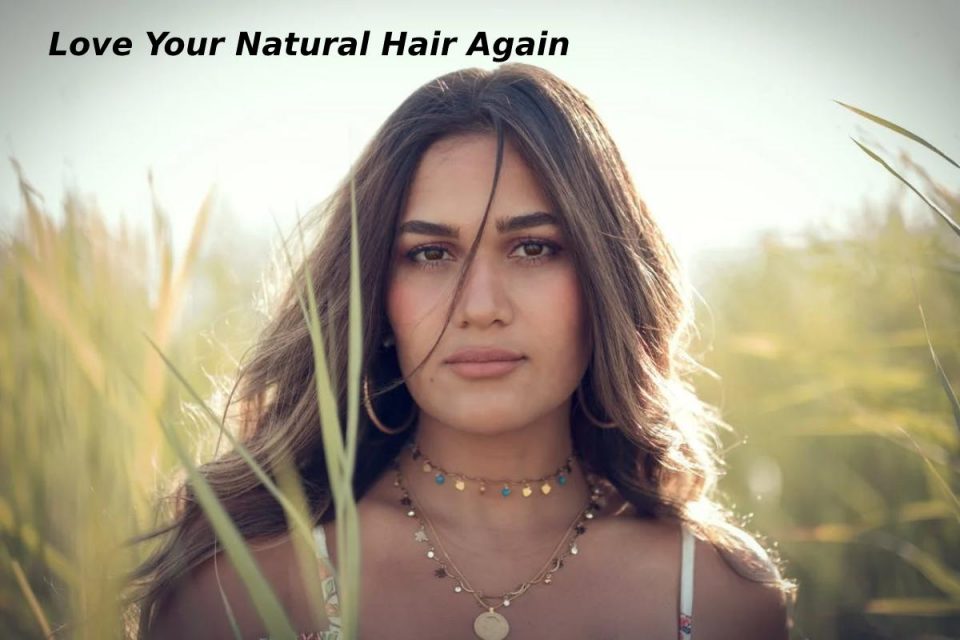
Natural Hair is not a trend or a single routine—it is a biological structure with specific mechanical, moisture, and protein needs. When you understand how hair fiber behaves (rather than copying viral routines), you can reduce breakage, retain length, and build a personalized system that works long-term.
Problem → Agitation → Solution
Problem:
Most advice about natural hair is routine-driven (“use this oil,” “try this method”) rather than biology-driven.
Agitation:
This leads to product overload, inconsistent growth, dryness, and the false belief that natural hair is “hard to manage.”
Solution:
Treat natural hair like a material science problem—understand structure, stress points, and hydration mechanics. Once you shift from trends to fiber behavior, care becomes predictable and scalable.
Table of Contents
What “Natural Hair” Actually Means
Natural hair simply refers to hair that has not been chemically altered by relaxers, texturizers, or permanent restructuring treatments. But scientifically, it’s defined by:
| Factor | What Happens in Natural Hair | Why It Matters |
| Curl Pattern | Elliptical fiber shape creates bends | Bends = weak points prone to breakage |
| Sebum Distribution | Oil cannot travel easily down curves | Leads to dryness, not lack of oil |
| Shrinkage | Hair contracts as keratin bonds tighten | Sign of elasticity, not damage |
| Cuticle Lift | Curves raise cuticle layers | Higher moisture loss |
Dermatology research, summarized by organizations like the American Academy of Dermatology, notes that curlier fibers are structurally more fragile due to uneven stress distribution along the strand.
Translation:
Hair is growing. You’re just losing it at the end.
Why Most Natural Hair Advice Fails (And What Actually Works)
Myth-Based Approach:
“Use more oils.”
“Avoid washing.”
“Follow a miracle routine.
Popular Natural Hair Products
| Product | Category | Approx. Price (India) | Where to Buy | Best For |
| Cantu Shea Butter Leave-In | Moisturizing repair cream | ~₹830–₹949 | Amazon / beauty retailers | Dry, textured hair |
| SheaMoisture Curl Enhancing Smoothie | Curl cream | ~₹1,200–₹1,700 | Amazon / Pharmacies | Curl definition |
| Olaplex No.3 Hair Perfector | Bond repair treatment | ~₹1,180+ | Nykaa / salons | Damage repair |
| Naturali Curl Defining Crème | Lightweight styler | ~₹349 | Amazon | Budget-friendly routine |
| Curl Up Curl Care Bundle | Full regimen kit | ~₹1,500 | Flipkart | Beginner routines |
Different Natural Hair Colors
| Natural Hair Color | Melanin Composition | Common Regions | Texture Pairing Trends | Unique Care Needs |
| Black | High eumelanin | Africa, Asia | Coily, curly, straight | Needs moisture retention; prone to dryness |
| Dark Brown | Balanced eumelanin | South Asia, Latin America | Wavy to curly | Responds well to oil-based nourishment |
| Medium Brown | Moderate eumelanin | Europe, North America | Wavy/loose curls | Frizz control + protein balance |
| Light Brown | Reduced eumelanin | Europe | Fine to medium waves | Lightweight hydration |
| Blonde (Natural) | Low melanin | Northern Europe | Straight/wavy | UV + protein protection |
| Red/Auburn | Pheomelanin dominant | Ireland, Scotland | Wavy/curly | Sensitive to environmental damage |
| Grey/White | Loss of pigment | Global aging population | Any texture | Requires scalp-focused care |
Online Sales Share of Natural Hair Products
| Channel | Estimated Share |
| Online / E-commerce | 41% |
| Specialty Beauty Stores | 29% |
| Pharmacies | 18% |
| Direct-to-Consumer Brands | 12% |
Common Natural Hair Mistakes
| Rank | Mistake | Long-Term Effect |
| 1 | Detangling without lubrication | Immediate breakage |
| 2 | Over-manipulation | Cuticle erosion |
| 3 | Skipping trims | Split escalation |
| 4 | Heavy oils without hydration | Dryness cycle |
| 5 | Copying routines blindly | Inconsistent results |
Simple Diagnostic: What Does Your Hair Actually Need?
| If You Notice… | Your Hair Needs… |
| Snapping during combing | Slip + detangling control |
| Feels rough when dry | Conditioning cycle |
| Looks dull but feels soft | Clarifying cleanse |
| Breaks at same length | End protection strategy |
| Shrinks but feels strong | Leave it—this is healthy elasticity |
Leading Hair & Scalp Specialists
| Doctor / Clinic | Country | Specialty | Why Known |
| Trichology-focused dermatology centers (multi-country networks) | USA / UK | Scalp disorders & textured hair science | Clinical approach to curl-pattern care |
| Advanced FUE & PRP practitioners (e.g., specialists highlighted in Pune listings) | India | Hair restoration + PRP | High-volume transplant experience |
| Cosmetic dermatology institutes | Europe | Botanical-based scalp therapy | Integration of medical + natural care |
| Multicultural hair research clinics | North America | Afro-textured hair biology | Focus on inclusive dermatology |
Conclusion: Natural Hair Is Predictable When You Understand It
Natural hair is not difficult—it’s misunderstood.
Once you shift from:
- Product obsession
to - Structural care
You stop chasing routines and start building a system based on:
hydration + mechanics + protection.
That’s what leads to real length retention, consistency, and healthier texture over time.
FAQ
Q1. Does natural hair grow slower than straight hair?
No. Growth rate is biologically similar; curl patterns just make length retention harder.
Q2. Do I need oils for natural hair?
Only for lubrication or sealing—not hydration.
Q3. How often should natural hair be washed?
As often as the scalp requires cleanliness; dryness is managed with conditioning, not avoiding water.
Q4. Is shrinkage a bad sign?
No. Shrinkage indicates elasticity and structural integrity.
Q5. What matters more—products or technique?
Technique. Mechanical handling determines most damage outcomes.
Conclusion
Natural hair is not a challenge to “manage” but a structure to understand. When you shift your focus from copying routines to supporting the biology of your hair—maintaining hydration, minimizing friction, reinforcing protein balance, and protecting fragile ends—you move from trial-and-error to consistent results. Growth becomes easier to retain, styling becomes more predictable, and the need for excessive products disappears.